Oct 9, 2026Procurement and Logistics Guide
What is the Difference Between EN71 and REACH? 5 Mistakes EU Toy Importers Keep Making
CE, EN71, and REACH are not the same thing. The 5 mistakes EU toy importers make, the gaps that hold shipments, and why pre-testing beats a failed container.
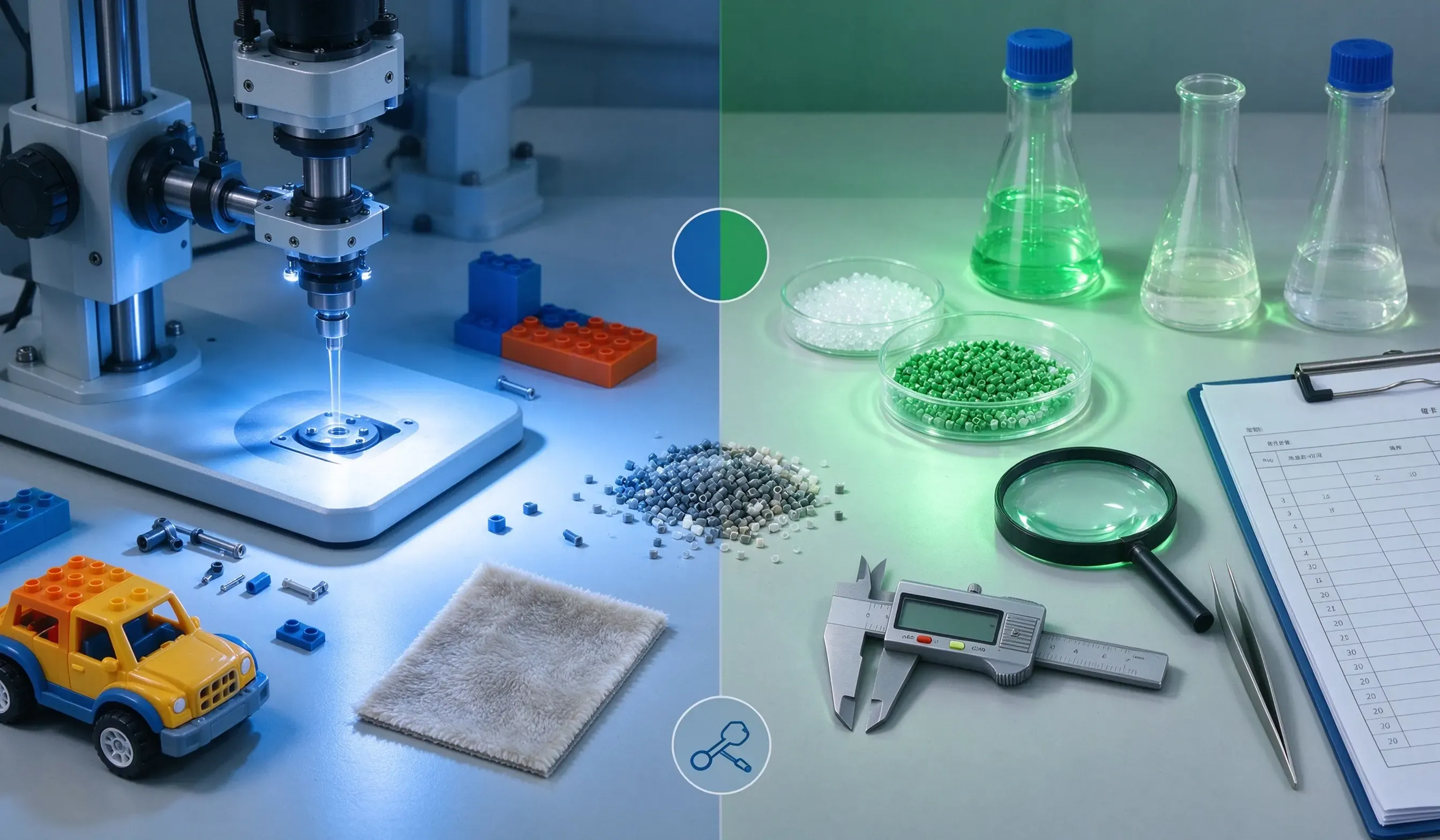
CE is not a certificate — it's a declaration you sign and a mark you affix, backed by a technical file. EN71 is the test standard behind the CE mark for toys (mechanical/physical, flammability, and restricted elements). REACH is a separate chemicals regulation that covers substances like phthalates and azo dyes, and it goes where EN71-3 stops. Passing EN71 does not mean you've cleared REACH — soft PVC, prints, and coloured coatings are the usual place phthalates sneak in. For a first EU order, pre-test a sample before mass production, not after.
Every EU-bound toy buyer has heard the words CE, EN71, REACH. Most can repeat them. Far fewer can tell you which one is a mark, which one is a test, and which one will hold your container at Rotterdam.
The difference matters because the confusion is exactly where shipments die.
The three names, in one line each
- CE — a conformity mark you affix and a declaration you sign. It is not a certificate you buy, and there is no central "CE certificate" a factory can hand you.
- EN71 — the European toy-safety standard, and the main technical basis for the CE mark on toys. It's the set of tests: mechanical/physical, flammability, and restricted elements.
- REACH — Regulation (EC) 1907/2006, a chemicals rule that covers all products, toys included. It limits substances like phthalates, azo dyes, PAHs, and heavy-metal-containing compounds.
So the relationship is: CE is the framework, EN71 is the toy test inside it, REACH runs alongside it. One mark, two rulebooks.
Why CE is a declaration, not a certificate
This is the single most expensive misunderstanding in EU toy importing, so it gets its own section.
A product is "CE marked" when the responsible person — for an imported toy, that's the EU importer or an authorised representative — signs an EU Declaration of Conformity (DoC), keeps a technical file, and affixes the CE mark to the product and packaging. A third-party lab can issue a test report that supports the declaration. The lab does not issue the CE mark.
Consequences importers miss:
- A factory's "CE certificate" is either a test report or a meaningless stamp. Neither is your Declaration of Conformity.
- If the goods are checked and there's no DoC and no technical file in the EU, the mark is non-compliant — even if the product physically passes every test.
- The UK left the EU framework. UKCA is a separate mark with its own DoC and its own authorised representative requirement. CE covers the EU; it does not cover Great Britain.
EN71: what actually gets tested
EN71 is where the physical and chemical safety of the toy is measured. The three parts buyers quote:
Part | What it covers | Why buyers care |
|---|---|---|
EN71-1 | Mechanical and physical properties — sharp points, small parts, projectile limits | The choking and injury baseline |
EN71-2 | Flammability | Sleepwear-level risk on plush and soft toys |
EN71-3 | Migration of certain elements — lead, cadmium, chromium, mercury, barium, antimony, selenium and others (19 elements in total) | The "heavy metal" limit everyone names |
There are more parts (EN71-9 for organic tin, EN71-10/11 for certain organics), but those three are the core and the ones most quoted.
REACH: the chemical net EN71-3 doesn't cast
Here is the trap your pre-shipment inspector won't necessarily flag.
EN71-3 limits the migration of specific heavy elements. REACH limits substances. Different scope, different lab methods, different failure modes. The phthalate restrictions under REACH Annex XVII (DEHP, DBP, BBP, DIBP at 0.1% each in plasticised material, with further limits on DINP/DIDP/DNOP) are not covered by EN71-3 at all. Azo dyes, PAHs, and nickel release live in REACH, not EN71.
That is why a toy can pass EN71 clean and still fail at the border on phthalates — and why soft PVC, prints, coloured coatings, and elastic components are the usual place it happens. The coloured sleeve on a wooden toy, the print on a PVC figure, the soft grip on a teether: all of them carry the phthalate risk EN71-3 never looked for.
The 5 mistakes that hold EU shipments
These are the ones seen repeatedly, in order of how often they sink a first order.
- Treating CE as a certificate. It's a signed declaration plus a technical file. Without the DoC in the EU, the mark is non-compliant.
- Assuming EN71-passed means REACH-cleared. EN71-3 checks heavy-element migration; REACH checks phthalates, azo dyes, PAHs. Different tests.
- Believing only PVC carries phthalates. Prints, inks, coatings, and elastic parts fail just as often. Test the coloured and soft bits, not just the body.
- Thinking the UK still runs on CE. Great Britain needs UKCA (or CE-with-UKNI, depending). CE alone doesn't clear GB.
- Assuming one report covers the whole container. Every children's SKU needs its own documentation, and a material or coating change drops that SKU out of coverage and forces a re-test.
What to do before the first EU order
If this is your first run at the EU market, the cheap insurance is a pre-test, not a post-mortem.
- Test a production-representative sample for EN71-1/2/3 and REACH phthalates, azo dyes, and PAHs — before mass production, not after.
- Assign an EU authorised representative and keep the DoC and technical file on file in the EU.
- Confirm the CE mark and traceability data (manufacturer/importer identity, item reference) are actually on the product and packaging, not just the carton.
- Lock materials across the range so a single report covers the family; change the coating and you re-open the chemical scope.
- Budget a holding buffer for one failed shipment, because the first EU run is where surprises happen.
【Toy-industry red lines in EU-bound compliance】
- CE is a declaration, not a stamp. A factory's "CE certificate" is a test report at best. The DoC and technical file are yours to hold.
- REACH is separate from EN71-3. Phthalates, azo dyes, and PAHs are not in EN71-3. Soft and coloured parts are the high-risk zone.
- UKCA ≠ CE. Great Britain is its own mark after Brexit. Don't assume one covers the other.
- Battery toys add another layer. A lithium cell brings UN38.3 + MSDS for transport, on top of the EU toy file.
- Every SKU stands alone. A family report holds only while every member matches what was tested; a material change re-opens the chemical scope.
- EN71-3 is migration, not total content. It measures what leaches out under simulated use, which is the right test — but it is not REACH.
FAQ
What is the difference between EN71 and REACH?
EN71 is the European toy-safety test standard (mechanical/physical, flammability, restricted element migration) and the technical basis for the CE mark on toys. REACH is a separate chemicals regulation covering phthalates, azo dyes, PAHs and similar substances across all products. CE is the mark and declaration that sits over both.
Does passing EN71 mean my toys comply with REACH?
No. EN71-3 limits the migration of specific heavy elements; REACH restricts phthalates, azo dyes, PAHs and more — different tests with different methods. A toy can pass EN71 and still fail REACH on phthalates in soft or printed parts.
Is CE a certificate I can buy from the factory?
No. CE is a conformity mark backed by the importer's Declaration of Conformity and technical file. A lab can issue a test report that supports it, but there is no central CE certificate, and the declaration is the importer's responsibility.
Do I need UKCA as well as CE for the UK?
For Great Britain, yes — UKCA is a separate mark with its own DoC and representative. CE covers the EU; it does not alone clear GB. Check the current transitional arrangements before quoting UK buyers.
What should I test before the first EU order?
A production-representative sample for EN71-1/2/3 plus REACH phthalates, azo dyes and PAHs, before mass production. Test the soft and coloured parts, not just the main body.
Who signs the EU Declaration of Conformity?
The EU importer or their authorised representative. As the importer you hold the DoC and technical file; your supplier provides the test data and product documentation that support it.
Looking for the toys mentioned in this article?
Browse our wholesale collection or contact us for a free sourcing quote. We reply within 24 hours.
Website: www.inluvtoys.com
Email: henry@inluvtoys.com
Phone / WhatsApp / WeChat: +86-13411918746