Oct 11, 2026Procurement and Logistics Guide
What 6 Labels Must German Toy Packaging Carry? One Missing Holds Your Container
Germany enforces the strictest EU toy labelling. The 6 must-print packaging items, German-only extras, and why one missing label holds your container.
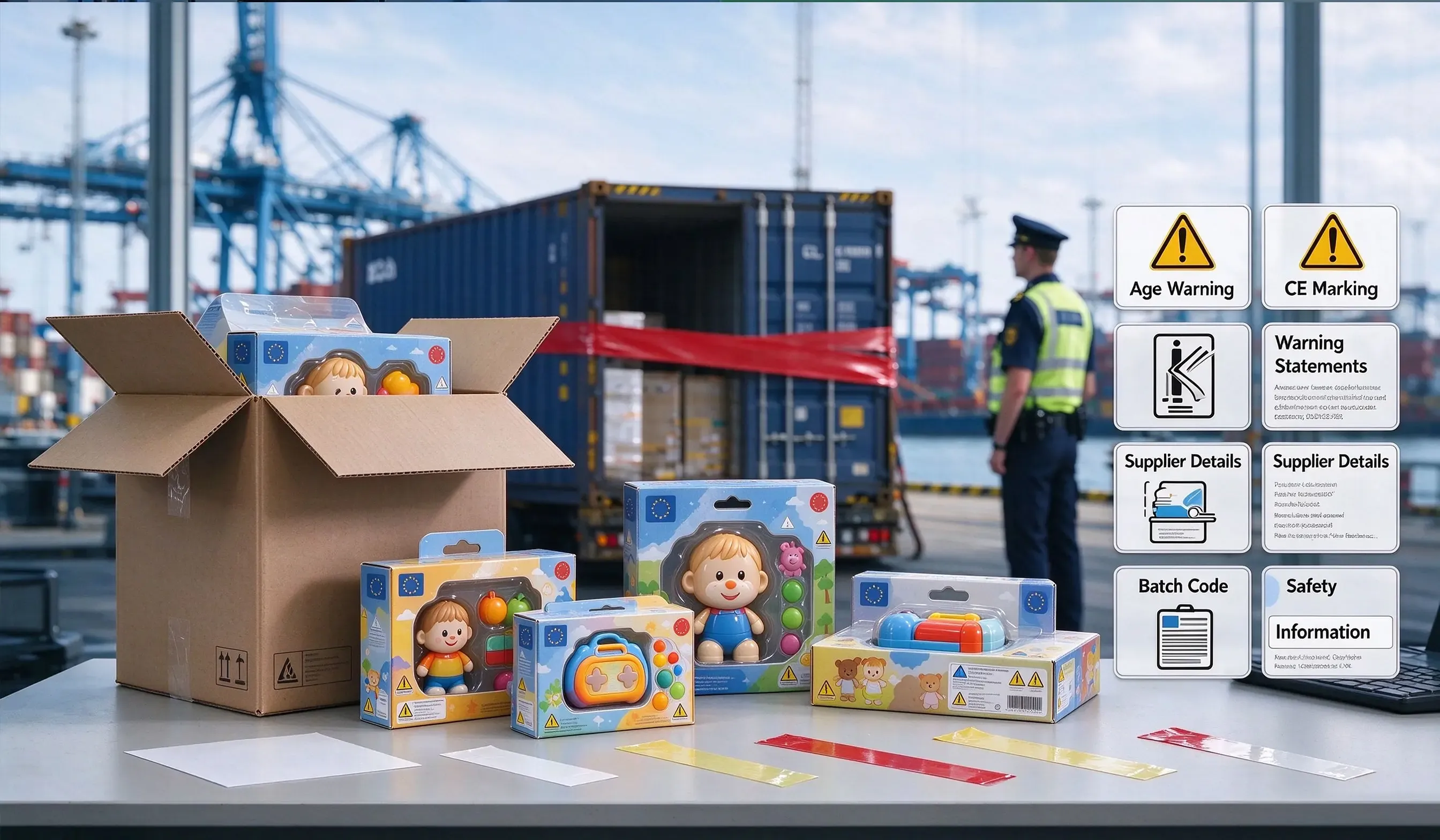
Germany runs one of the strictest toy-label regimes in the EU, and the container usually gets stopped after it lands, not at the border gate. Six items are mandatory on every toy headed for Germany: CE mark (≥5mm, correctly proportioned), the EU Responsible Person's name and address, model or batch identity, age grading (e.g. "3+"), the warning text in German, and material / fibre information. On top of the EU baseline, Germany adds its own traps — the Battery Act mark on battery toys, LUCID packaging registration for any importer selling into Germany, and fibre-content labelling on plush. Send the packaging artwork to your German customs broker before mass production, not after.
Most toy importers learn German labelling the expensive way: the goods are already in Hamburg or Bremerhaven, the paperwork is wrong, and the demurrage clock is running. The label isn't a design detail. It's the difference between a released container and a stored one.
The 6 items you cannot ship without
These apply to every toy sold in Germany, because Germany is an EU member and enforces the EU Toy Safety Directive (2009/48/EC) on top of its own national checks.
| Item | What "right" looks like | Where buyers slip |
|---|---|---|---|
1 | CE mark | Height ≥ 5 mm, correctly proportioned, clearly visible, not obscured by other marks | Printed too small, or stretched out of proportion |
2 | Manufacturer or EU Responsible Person | Legal name + postal address of the manufacturer, or the EU Responsible Person (an entity established in the EU) | Only the Chinese factory name, or no EU entity at all |
3 | Model or batch identity | Item reference or batch / lot number, traceable to production | Generic packaging with no way to trace a unit back |
4 | Age grading | Mark like "3+" matching the assessed age group | Missing, or contradicting the warning below |
5 | Warning text in German | Required hazard warnings inGerman — e.g. small-parts choking warning — not just English | English-only warnings, which German customs and platforms reject |
6 | Material / fibre information | Material stated; for plush/textile parts, fibre composition | "Plastic" left vague, or plush with no fibre label |
The choking warning is the one that catches plush and small-part toys most often. The German wording is not optional — a small-parts toy must carry the choking-hazard statement in German, and the age grading above it has to agree with it.
Why "English is fine" is a costly assumption
A warning printed only in English is the single most common reject on German toy shipments, and it isn't a customs nicety. EU rules require the hazard warnings to be in the language of the country where the toy is sold. For Germany that means German — on the packaging and, where relevant, on the product itself.
Amazon.de and other German platforms enforce this too, so even if a lenient customs check lets a batch through, the listing can still be taken down. The fix is cheap and front-loaded: get the German wording confirmed before the artwork goes to print, not when a broker emails you a photo of the rejected carton.
German-only extras the EU baseline doesn't mention
These four are where Germany diverges from "just CE," and they are the ones importers don't expect.
- Battery Act mark (BatterieG). Any toy with a battery must carry the crossed-out wheeled-bin symbol, and, if the battery contains certain heavy metals, the relevant chemical symbol (Hg, Cd, Pb). Battery toys without it fail German checks.
- LUCID packaging registration (VerpackG). Any importer placing packaged goods on the German market must register in the LUCID database and join a dual system, and the packaging carries the relevant recycling mark. This is Germany-specific and applies even if the toy itself is fully compliant.
- Fibre-content labelling on plush. Under German textile-labelling rules, a plush or textile-bodied toy carrying fabric must show its fibre composition — in German. Plain "plush" is not enough.
- GPSR Responsible-Person presence. The General Product Safety Regulation (in force from late 2024) tightens the EU Responsible Person requirement and the local-language warning rule across the EU, with Germany among the strictest enforcers. Confirm the current obligations before quoting, because the rules are recent and still settling.
What to send to your broker before production
The cheap insurance is a pre-print review, not a post-shipment apology.
- Send the packaging artwork — not a description, the actual file — to your German customs broker and let them check CE size, Responsible Person block, German warnings, and the German-only marks.
- Confirm the factory prints German, not English, on warnings and any material text.
- Register LUCID before the first shipment if you sell into Germany at any volume.
- Lock the artwork once approved so a "minor" reprint doesn't drop a required element.
- Keep a holding buffer for one flagged shipment, because the first German run is where label surprises surface.
【Toy-industry red lines in German toy labelling】
- German warnings are mandatory, not suggested. English-only text gets rejected by customs and platforms alike.
- CE ≥ 5 mm and proportioned. A stretched or undersized mark is treated as missing.
- EU Responsible Person must have an EU address. A China-only manufacturer block doesn't satisfy the rule.
- Battery toys need the Battery Act symbol. Lithium cells also bring UN38.3 + MSDS for transport.
- LUCID is Germany-specific. Selling into Germany without it is a registration gap, not a labelling one.
- Plush needs German fibre composition. "Plush" alone fails the textile rule.
FAQ
What 6 things must be on toy packaging for Germany?
CE mark (≥5 mm), the manufacturer or EU Responsible Person name and address, model or batch identity, age grading, the hazard warning in German, and material or fibre information.
Does the CE mark need to be a specific size?
Yes — at least 5 mm high and in correct proportion. A stretched or shrunk mark reads as non-compliant, even if present.
Can the warning text be in English, or must it be German?
It must be German for the German market. EU rules require hazard warnings in the language of the selling country, and German customs and platforms reject English-only text.
What is the EU Responsible Person, and do I need one for Germany?
It's an entity established in the EU who is the legal contact for compliance. You need one for any toy sold into the EU, including Germany; a China-only manufacturer block does not satisfy the requirement.
Are there German-only marks beyond the EU toy label?
Yes — the Battery Act symbol on battery toys, LUCID packaging registration for any importer selling into Germany, and German fibre-composition labelling on plush. These are Germany-specific and sit on top of the EU baseline.
What should I do before mass production to avoid a held container?
Send the actual packaging artwork to your German customs broker for a pre-print check of the CE size, Responsible Person block, German warnings, and the German-only marks, and register LUCID before the first shipment.
Looking for the toys mentioned in this article?
Browse our wholesale collection or contact us for a free sourcing quote. We reply within 24 hours.
Website: www.inluvtoys.com
Email: henry@inluvtoys.com
Phone / WhatsApp / WeChat: +86-13411918746