Oct 2, 2026Custom Case
Should You Pay for the Mold? How Do You Choose Between OEM and ODM Toys in 2026?
OEM vs ODM toys explained for importers: who pays the mold fee, when "exclusive" isn't real, and how safety certification is split between you and the factory. Original sourcing by InLuv Toys.
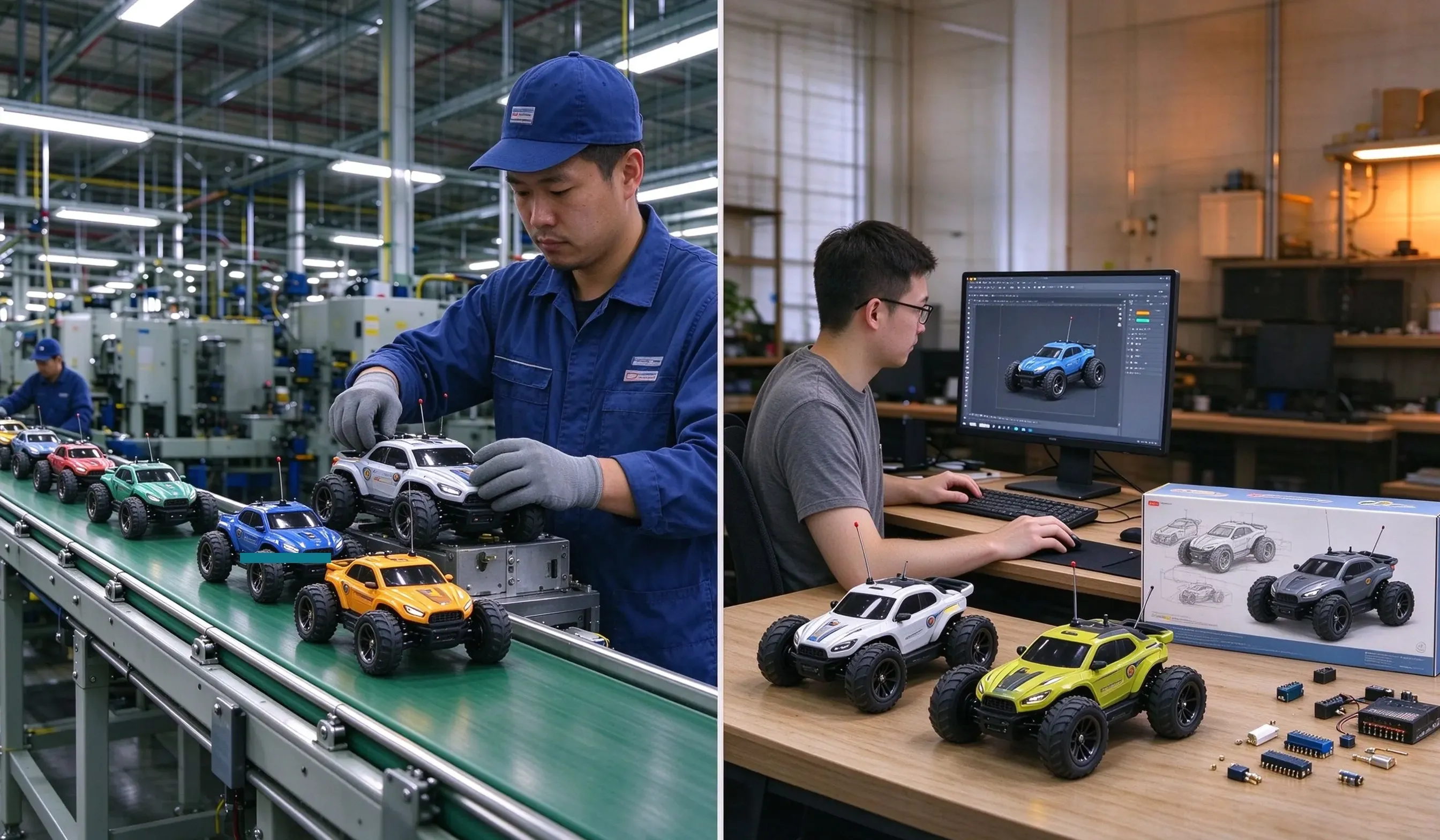
The difference between OEM and ODM is one sentence — OEM you build from your idea, ODM you customise from the factory's idea. That sentence is useless for deciding anything. What decides it is the mold fee, the exclusivity clause, and who carries the safety certification. Pay for a mold only when your reorder volume can pay it back inside one season, and even then, only if the contract says who owns the mold and what happens when the exclusivity ends. Most importers run both at once: ODM to prove demand, OEM once the number is real.
Every sourcing blog will tell you OEM means the buyer designs and ODM means the factory designs. Big reveal. That line takes you four minutes to read and zero yuan to act on, which is exactly why it survives — nobody gets in trouble for stating the definition correctly.
The question that actually costs you money is smaller and duller: who pays for the mold, who owns it, and can a competitor be selling the same thing next month?
The definitions, in one line each, then we move on to the money
You can skip most of what follows if all you needed was the textbook version:
- OEM (Original Equipment Manufacturing) — you bring the idea, drawings, structure, function, and packaging direction. The factory builds to your spec.
- ODM (Original Design Manufacturing) — the factory already has the product, the molds, and the production know-how. You pick it and adjust colour, logo, print, packaging, and minor functions.
That's the whole textbook. Now the part that decides whether this costs you money or saves it:
Three questions decide this, not one
Forget "which is better." Ask these three. The answers point at one column in the table below, every time.
1. How many units can you honestly reorder?Not what you hope. What your sales channel can physically move in two seasons. OEM needs enough volume to make the mold fee average out. ODM needs nothing — you can sell ten cartons if you want.
2. When does it have to sit on a shelf?If the answer is "before the next peak season," ODM wins. Sampling, revision rounds, and structure confirmation in OEM eat weeks, and none of that slows down because you're in a hurry.
3. Are you selling a brand or a SKU?A SKU is a number in someone's catalogue — replaceable, price-comparable, one click from the next option. A brand needs the customer to recognise yours. Exclusivity is a brand tool. If you don't have one yet, ODM gets you to shelf faster and you can switch later.
Your situation | What it points at |
|---|---|
Small trial, no design team, needs product inside 6–8 weeks | ODM |
Testing a new category in a new market | ODM |
Established volume, clear spec, needs the competition to copy something impossible | OEM |
Private label programme with a 3-year plan | OEM |
Still guessing whether the product will sell | ODM first, OEM on the winner |
Already proven seller, want the equivalent product without your name on it | ODM light customisation |
The mold fee is the entire argument
This is where OEM turns from "customisation" into "a line item you can't get off the books."
Mold cost in the Chenghai / Shantou cluster runs from a few thousand RMB for simple parts to a mid-five-figure RMB range for multi-cavity or complex structures. Treat that as a range for planning, not a quote — get the factory to price it item by item, because the number that matters isn't the mold, it's what the mold does to your unit price across the volumes you'll actually order.
Run this before you sign anything:
Mold fee ÷ (ODM equivalent unit cost − your OEM unit cost) = units you must buy to break even.If that number is larger than your realistic 12-month volume, you are paying for a mold you will never pay back.
That calculation kills more OEM projects than any objection from your supplier. Most buyers never run it. They see "we can do custom moulds for you" and feel like the factory is doing them a favour.
If the break-even lands inside your volume, the mold usually pays for itself twice — cheaper unit price, and something a competitor cannot buy off a catalogue.
Three things to write into the contract before the mold is cut
Potentially the most expensive sentence in toy sourcing is an assumption.
- Who owns the mold? Paying for it does not make it yours. Ask for the mold owner named in writing on the commercial invoice or the mold agreement. Unowned molds end up in a second buyer's production run.
- Is the mold exclusive, and for how long? An "exclusive mold" with no end date, no territory, and no penalty is a marketing word. Exclusivity needs a term, a territory, and a price.
- What happens to the mold when the exclusivity ends? Destroyed? Held for your reuse? Sold to the open mold market at the next cheaper buyer's request? All three happen. Ask which one legally applies.
"Exclusive" is frequently a word, not a fact
Here's the bit that stings. An ODM product built on a shared mold is shared product. The factory is selling the same mold to other buyers, probably to buyers in your own country, possibly on Amazon next to your listing at a lower price.
Ask the question directly: how many other customers are on this mold? Not "does this product exist elsewhere" — that's guaranteed. You want the number.
And if the answer is one, find out what it costs to make it contractually true. Territory exclusivity on a mold is a negotiable thing. It is also frequently not offered, because the factory's whole model depends on spreading one mold across many buyers to keep unit cost down.
OEM is not a shield either. The mold is yours, sure — but the mould can be replicated from a sample, the shape can be approximated, and in toys the thing that gets copied is your photograph, not your tooling. Design something that is hard to copy from a photo, or you paid for a mold and still got a clone.
The paper neither model lets you skip: safety certification
Factory-side blogs love this section because it sounds like compliance theatre. It isn't. In OEM and ODM the split of responsibility is genuinely different, and getting it wrong puts the letterhead on someone else's test report.
| OEM | ODM |
|---|---|---|
Who defines the product structure | You | Factory |
Who supplies the test sample | You (or you commission it) | Factory |
Who sends it to the lab | Usually you | Usually you, even on ODM |
Whose name is on the report | Yours, if your entity is the applicant | Often the factory's or a trading name |
Who holds the local market cert | Your importing entity | Your importing entity |
Who owns the risk if the spec drifts | You | Factory —until you change anything |
Read the last row twice. On ODM, the factory's existing report covers the product as it was tested. The moment you change the colour masterbatch, swap the battery, shorten the pin, or lighten the plastic, the report no longer describes what you're shipping. That is on you, and the label on your carton says your company.
Practically, for building blocks and RC lines:
- Blocks: EN71 (EU) and ISO 8124 as the baseline. Per SKU, not one shared certificate for a catalogue.
- Electric / RC: IEC 62115 for the toy itself, plus UN38.3 and MSDS for any lithium cell — UN38.3 is a transport test, not a toy safety clearance, and mixing those two up ends containers at the port.
- Under-3: no detachable small parts, and the warning text must match the final structure.
- Local cert: SNI / TISI / QCVN / SIRIM / INMETRO / NOM / GCC belongs to your importing entity. Your supplier hands you the test files. They do not hand you the market approval.
The mix most importers actually run
Pure OEM or pure ODM is tidy for a blog post. Real sourcing looks like this:
ODM now, OEM on the winner.
- Put 3–5 ODM candidates in the market under your packaging. Low cost, fast, and you learn what actually sells.
- Watch sell-through and repeat rate for one season.
- Take the one with real repeat demand and build your own version — structure, function, finish — so nobody else can sell it next door.
The gate between step 2 and step 3 is the break-even calculation above. If the mold pays back inside the season, make it. If not, you bought a mold to feel distinctive and ended up with a warehouse full of it.
This route is why "which model fits my business" is the wrong question. The honest answer is both, sequenced — and the sequence is set by sell-through data, not by how customised your brief sounds.
【Toy-industry red lines in OEM / ODM】
Things that go wrong in this industry specifically, not generic sourcing:
- Same mold, different material, valid label. A factory can changeABS grade or colour masterbatch and still point at last year's report. Re-test or demand a written material change note on every reorder.
- ODM RC toys often ship without cells, or with non-branded ones. If the product needs batteries, get UN38.3 and MSDS for the actual cell in the carton, not for a generic battery in their file.
- You changed the structure, you own the risk. A "small functional tweak" that makes an age grading change — a removable magnet, a smaller screw, a new battery bay — can turn a compliant 3+ item into a choking hazard class. Re-evaluate after every structural change.
- Your OEM drawing can be the infringement. If you hand a factory a design copied from someone's catalogue, you didn't outsource the IP risk, you supplied it. Original, non-IP designs only.
- Artwork and manual language are yours to fix. ODM factories default to English or generic multi-language inserts. SNI, TISI, and Arabic or Vietnamese labelling are not included in "custom packaging."
- Sample ≠ mass production. The sample that passed EN71 in the lab may have been hand-assembled. Insist the test sample matches the production structure and that AQL 2.5 inspection runs on your actual batch.
The five questions to ask before you place anything
Send these to a supplier and read the answers like a reporter, not a buyer:
- Is this mold shared or exclusive? Can exclusivity be written into the contract, with a territory and an end date?
- Who owns the mold on paper, and what happens to it when exclusivity ends?
- Can you show the original EN71 / IEC 62115 report for this SKU, and was the tested sample the production structure?
- If I change the colour, the material, or the battery on the reorder, does the report still cover it — and who pays for re-testing?
- On ODM, how many other buyers are on this mold, and in which countries?
A supplier who answers all five is a supplier. One who answers three and offers a discount is telling you the other two.
FAQ
What's the real difference between OEM and ODM toys?
OEM you build from your own spec and drawings; ODM you pick a factory design and customise colour, logo, packaging, or minor function. That's the definition — the decision depends on mold cost, reorder volume, and exclusivity terms.
When does it make sense to pay for a mold in toys?
When your realistic 12-month volume can push the mold fee to break even inside one season, and the unit cost saving plus the difficulty of copying the product justifies the spend. Calculate it before you sign.
Can I get exclusive rights on an ODM toy?
Only if the mold is exclusive and the exclusivity is written into the contract with a territory and a term. On a shared mold, other buyers — sometimes in your market — are selling the same product. Ask how many.
Does OEM or ODM change who owns the safety certification?
Yes. In OEM you define the structure and normally own the test files; in ODM the factory's report covers only the product as originally tested, so any change to colour, material, or battery invalidates it and re-testing is your cost.
Can I start with ODM and move to OEM later?
Yes, and it's the common route. Prove demand with ODM first, then build your own version of the winner once the volume justifies the mold. The gate is the break-even calculation, not the calendar.
How do I know a cheap mold fee is a trap?
When it's cheap because the mold isn't yours, or because the factory expects you never to reorder enough to cover it. Check mold ownership in writing and run the break-even math before you commit.
Plan Your First Custom Toy Run:👉 [Request a Quote at InLuv Toys] · tell us your target market and the product you're considering, and we'll tell you honestly whether ODM or OEM fits your volume — plus the per-SKU compliance files and mold terms before you commit.
Website: www.inluvtoys.com
Email: henry@inluvtoys.com
Phone / WhatsApp / WeChat: +86-13411918746