Procurement and Logistics Guide
How to Import Toys from China to Mexico: NOM & Customs
Learn how to import toys from China to Mexico—NOM-015 labeling, NOM-252 safety, RFC/Padrón, pedimento, and the step-by-step import process.
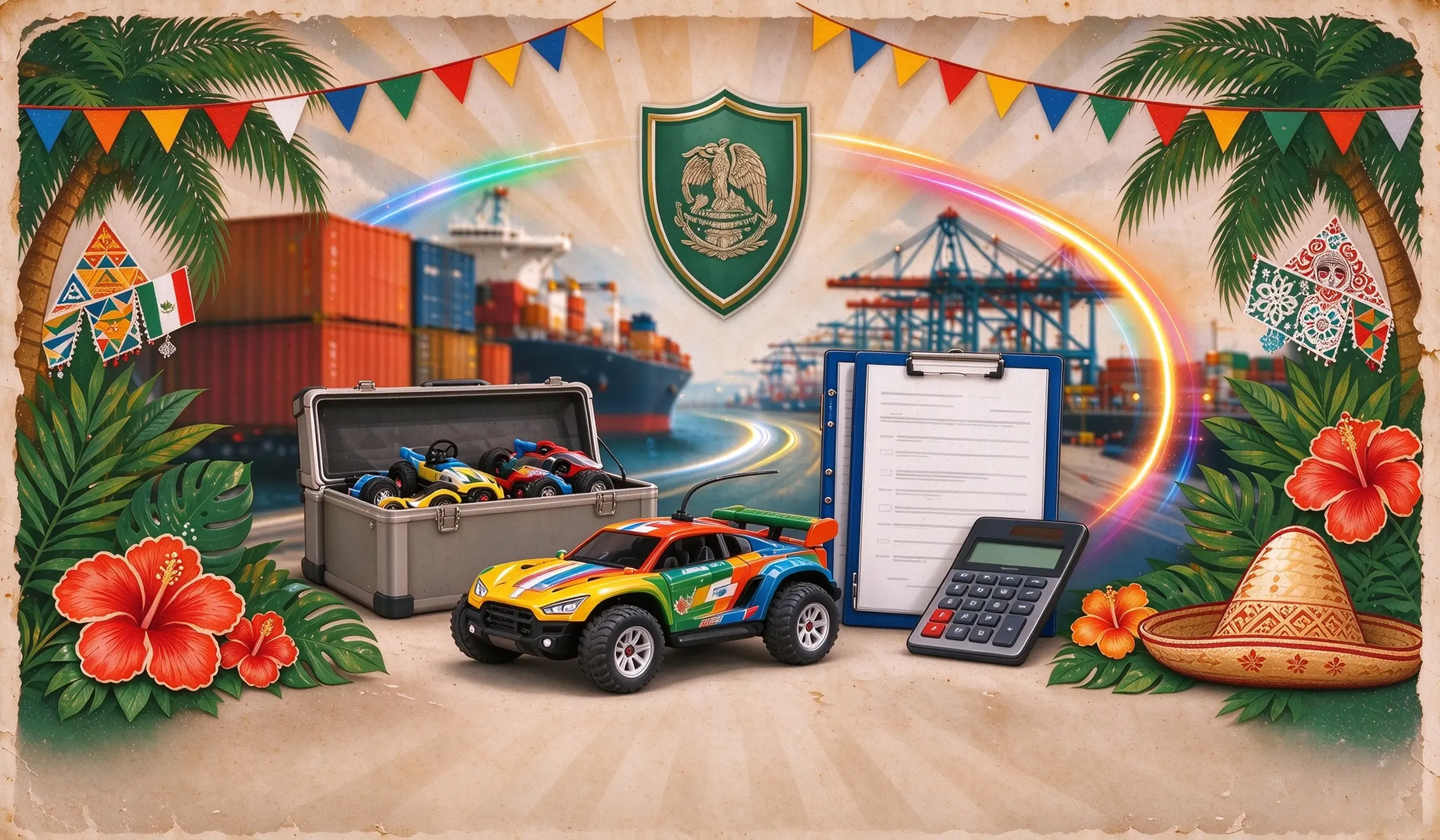
How to Import Toys from China to Mexico: Regulations, Labeling Requirements & Import Process
Importing toys from China to Mexico involves more than choosing products, placing an order, and arranging transportation. First-time importer's need to coordinate the product itself, Mexican import requirements, tariff classification, labeling, documentation, and customs clearance before the goods enter the Mexican market.
The most practical way to approach the process is to work backward from the product you intend to sell: define the toy → confirm its classification → identify applicable requirements → prepare labeling and documents → coordinate production and shipment → complete customs clearance.
This guide explains the process from a beginner's perspective and shows where a China-based toy sourcing partner can support the supplier-side work. It is informational; for any specific shipment, confirm current requirements with Mexico's tax and customs authorities and a licensed customs broker (agente aduanal).
What Should You Prepare Before Importing Toys from China to Mexico?
Before contacting a supplier, a Mexican buyer should establish whether the business and product are ready for import.
Confirm Your Importer Status in Mexico
Businesses and individuals intending to import merchandise into Mexico generally need to be registered with the Padrón de Importadores (Importer Registry) under the SAT (Tax Administration Service). SAT currently requires, among other conditions, an active RFC (tax ID), a valid e.firma (advanced electronic signature), compliance with tax obligations, a fiscal address, and a validated Buzón Tributario. SAT also requires the importer to have an authorized customs agent, customs attorney, or legal representative handling foreign-trade operations. https://www.sat.gob.mx/
This is an importer-side responsibility. A Chinese toy supplier does not replace the Mexican importer or its customs representative.
Define the Toy You Plan to Import
The exact product matters because "toy" is too broad to determine every applicable requirement.
Before ordering, document: product type and function, main materials, intended age group, whether it uses batteries or another power source, components and accessories, packaging configuration, product quantity, and intended sales channel. A simple plastic construction toy and a battery-operated electronic toy may require different technical and regulatory considerations.
Confirm the Product's Tariff Classification
Determine the applicable fracción arancelaria (tariff classification) before calculating the total import cost. Mexico uses a 10-digit code (8 from the Harmonized System plus 2 from the Mexican TIGIE/NIC); toys generally fall under 9503. Tariff classification affects the customs declaration, applicable duties (IGI), and non-tariff regulations. https://www.ventanillaunica.gob.mx/
What Mexico Toy Import Regulations Should You Check?
Once the product is clearly defined, determine which Mexican requirements apply.
NOM-015-SCFI-2007 for Toy Labeling
One of the key standards for toys marketed in Mexico is NOM-015-SCFI-2007, Información comercial–Etiquetado para juguetes. Mexico's Ministry of Economy currently lists it as vigente (in force). It establishes commercial-information requirements for toys marketed in Mexico and applies to toys made from any material, including battery-operated toys. https://www.gob.mx/economia
https://www.dof.gob.mx/
NOM-252-SSA1 for Toy Safety (the compliance layer competitors often skip)
Beyond labeling, toy safety is covered by NOM-252-SSA1 (toys' safety—toxic substances, small parts, and related limits), overseen by COFEPRIS / the health authority. NOM-015 should not be treated as a universal checklist: a label can be perfect while the product still fails mechanical, chemical, or small-parts requirements. https://www.gob.mx/cofepris
Other Requirements Depend on the Toy
Additional considerations depend on characteristics such as electrical functions, batteries, product construction, intended use, components, and tariff classification. The compliance process should begin with the actual product rather than a generic list of "toy regulations."
What Are the Toy Labeling Requirements in Mexico?
Labeling should be addressed before production, not after the toys arrive in Mexico.
What Information Does NOM-015-SCFI-2007 Require?
Mandatory commercial information can include: the generic name when not readily identifiable, quantity where applicable, manufacturer or responsible-party information, country of origin, the importer's name and fiscal address for imported products, the recommended consumer age indication, battery or power-source information where applicable, and nominal electrical information for toys above the specified voltage threshold. The standard has specific conditions and exceptions, so check the packaging against the applicable provisions rather than copying another product.
Do Toy Labels Need to Be in Spanish?
Mandatory label information must be presented in Spanish, although additional languages may be used. The information must remain available to the consumer until purchase and be legible. If a Chinese supplier produces packaging for another market, the Mexican importer may need to adapt labeling before commercial distribution.
What About Instructions and Warnings?
NOM-015 also addresses instructions, warnings, and specific product situations. Toys intended to be assembled must include assembly instructions. Safety warnings—including small-parts warnings for younger children—depend on the toy's characteristics and should be identified during product development, not added generically at the end.
What Documents Are Needed to Import Toys from China?
The exact package depends on the product and operation, but a first-time importer should expect several categories.
Import and Customs Documentation
Typical commercial and logistics documents include the commercial invoice, packing list, transport documents, and the pedimento (customs declaration). The pedimento records key information about the imported merchandise—classification, origin, value, and applicable regulatory compliance—and is filed by a licensed customs broker.
Product Compliance and Supporting Documents
Depending on the toy, the importer may also need supporting product information: product specifications, packaging and label information, instructions, test reports (for NOM-015/NOM-252 as applicable), battery or electrical information, and other documents tied to applicable regulations. There is no single test-report package applied to every toy; evidence should follow the product's characteristics.
How to Import Toys from China to Mexico Step by Step
For a first-time buyer, the process simplifies into six stages.
Step 1 — Select and Define the Product. Start with the actual product: specifications, materials, function, intended age, packaging, quantity, and target market. Document each product separately if considering several.
Step 2 — Confirm Classification and Applicable Requirements. Before production, determine the tariff classification and identify the regulations attached to it (NOM-015 labeling, NOM-252 safety, any sector-specific rules). Involve a Mexican customs professional; do not rely only on a supplier's suggested HS code for the final determination.
Step 3 — Confirm the Chinese Supplier's Product Information. The supplier provides specifications, materials, dimensions, packaging configuration, carton details, quantity per carton, photos or samples, and available test or compliance documents. Accurate information lets the importer and broker decide on the actual product.
Step 4 — Finalize Labeling and Packaging Before Production. For a Mexican-market product, review required labeling before mass production. Changes are far cheaper before finished goods exist—especially for private-label products.
Step 5 — Arrange Shipment and Customs Clearance. After production, ship from China to Mexico. The flow: factory → export shipment → Mexico arrival → pedimento filing → customs clearance → release. The Mexican importer and its broker remain responsible for the import; the Chinese supplier primarily provides accurate product and shipping information.
Step 6 — Receive and Distribute the Toys in Mexico. After customs procedures complete, move goods into domestic distribution. The product should already be prepared for Mexico—not treated as a generic China-market product that only needs international shipping.
How Can a China Toy Supplier Help With the Import Process?
A supplier cannot take over the Mexican importer's legal responsibilities, but it can reduce China-side complexity through sourcing, factory coordination, customization, and organized documentation.
Help You Find Suitable Toy Products and Factories
For a first-time buyer, the challenge is finding a factory that can produce the right product and provide the documentation NOM and customs require. InLuv Toys works with Shantou-based factories on building blocks and RC toys, and can help buyers compare sources and request samples before committing to bulk orders.
[building blocks wholesale category] [RC toy wholesale category]
Coordinate OEM/ODM Requirements
For brands needing more than a catalog product, InLuv Toys provides OEM and ODM solutions and can coordinate specifications, colors, packaging, branding, and the compliance documents buyers need—confirmed before production so finished products and information stay consistent with the import plan.
Keep Supplier-Side Information Organized
A sourcing partner helps coordinate communication around product specifications, packaging, production, quality control, available test reports, and shipment information—while the Mexican importer remains responsible for local compliance and customs. See [toy sample approval SOP] for our review process.
Conclusion: Prepare the Import Before the Shipment
Importing toys from China to Mexico is easier to manage when compliance starts before production rather than at customs. The essential sequence: define the product, confirm its classification, identify applicable Mexican requirements (NOM-015 labeling and NOM-252 safety), prepare labeling and documents, finalize production, then arrange shipment and clearance.
A China-based sourcing partner supports the supplier side—sourcing, samples, OEM/ODM, and organized documentation—while Mexican importers work with the appropriate local authorities and a licensed customs broker. Planning a Mexico shipment or comparing toy supplier quotations? Send InLuv Toys your product reference, target market, and expected quantity via [INTERNAL LINK: request a comparable quotation], and we will help you clarify specifications and plan a compliant import. Learn more at [about InLuv Toys / Shantou supply].
FAQ
Q: What importer registration do I need to import toys into Mexico?
A: You generally need an active RFC (tax ID), registration in the Padrón de Importadores under SAT, a valid e.firma, and a validated Buzón Tributario, plus an authorized customs agent. These are importer-side responsibilities a Chinese supplier cannot fulfill.
Q: Do toys imported to Mexico need NOM certification?
A: Yes. Toy labeling follows NOM-015-SCFI-2007, and toy safety follows NOM-252-SSA1 (toxic substances, small parts). Confirm the exact applicable NOMs for your specific product with the relevant Mexican authority before import.
Q: What documents are required to clear toys through Mexican customs?
A: Expect a commercial invoice, packing list, transport document, the pedimento (customs declaration filed by a licensed broker), and product compliance documents such as test reports tied to NOM-015/NOM-252.
Q: Do toy labels have to be in Spanish?
A: Yes. Mandatory label information under NOM-015-SCFI-2007 must be presented in Spanish, including country of origin, importer details, recommended age, and applicable warnings, with legible presentation.
Q: Can a Chinese supplier handle Mexican customs for me?
A: No. The importer of record must be a Mexican entity with RFC and Padrón registration; a foreign company cannot be named on the pedimento. A China supplier supports the supplier side—sourcing, documentation, and shipment—while you handle local compliance.
Website: www.inluvtoys.com
Email: henry@inluvtoys.com
Phone / WhatsApp / WeChat: +86-13411918746