Oct 5, 2026Procurement and Logistics Guide
How Much Does CPC Certification Really Cost? 6 Expenses Most US Toy Importers Budget Wrong
How much does CPC certification cost when importing toys from China? 6 expenses most US importers budget wrong, plus how to check a CPC before shipping.
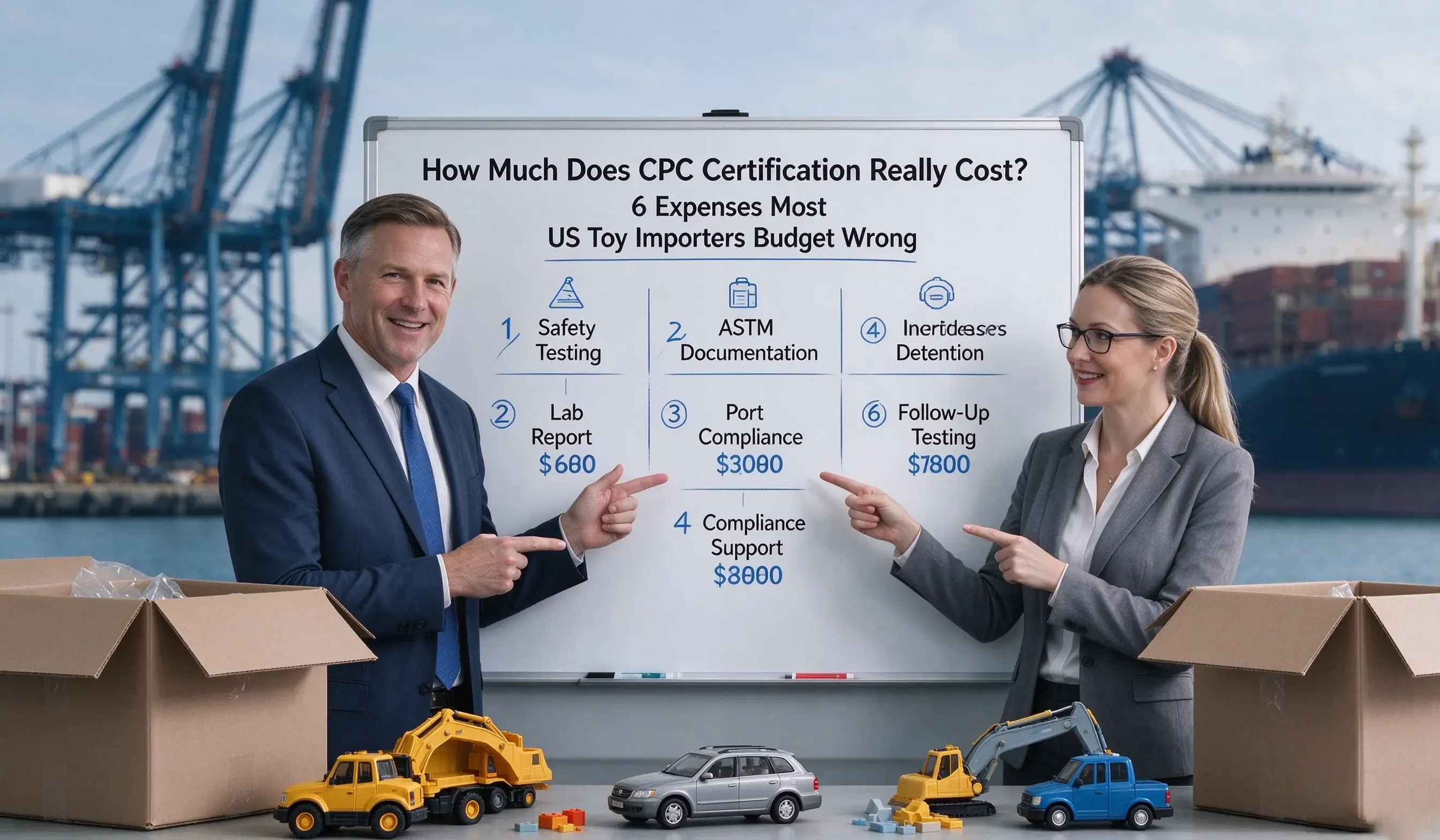
CPC isn't a certificate you buy — it's a statement you sign, built on a test report from a CPSC-accepted lab. Single plastic block SKU typically lands around USD 380–450 to test; battery RC models run higher, roughly USD 600–900, depending on part count and which standards get triggered. That one number is the price of one product, tested once. The real budget has six lines, and the sixth — a container sitting at the port because the paperwork didn't match the goods — costs more than everything else combined. Ask the factory for the test report behind the phrase "we have CPC," then check the model number, the lab's CPSC acceptance, and who actually signs the certificate.
Every US-bound toy buyer meets CPC the same way: someone says "you need CPC," you nod, and then you try to price it. The lab quotes a number, the factory says "we already have that," and the invoice arrives looking reasonable.
Then the container gets held.
What you're actually buying: a statement, not a certificate
This is worth thirty seconds because getting it wrong changes who carries the risk.
CPC = Children's Product Certificate. Under CPSIA, any product designed or intended for children 12 and under sold in the US needs one — and it is not a document the lab hands you with a stamp. It's a declaration that someone (the manufacturer, the importer, or an authorised representative) signs, stating the product meets the applicable CPSC rules, based on a test report from a CPSC-accepted third-party laboratory.
Two consequences importers consistently miss:
- The lab gives you a test report. You issue the CPC. A certificate sitting in the factory's folder, bearing the factory's name, does not cover your shipment. As the importer, the declaration is yours to hold and yours to defend.
- Non-children's products fall under a General Certificate of Conformity (GCC) instead. The line matters when your catalogue straddles it — mix age ranges in one range and you'll have both.
The one number everyone quotes — and what it leaves out
Practitioner ballpark, not a quote: testing one plastic building-block SKU typically runs about USD 380–450; an RC or battery-powered model usually lands higher, around USD 600–900. Treat it as a planning range and get an itemised lab quote, because the price moves with:
- Part count and assembly complexity — more small parts means more mechanical-physical testing.
- How many standards get triggered — mechanical/physical, flammability, lead in substrates and coatings, phthalates, and any product-specific rule (magnets, for example) are separate line items.
- Material and electronics — metal, mixed materials, and battery compartments all add test scope.
- Whether the lab is CPSC-accepted. Cheap labs that aren't on the accepted list produce reports you cannot build a CPC on.
That number covers one product, tested once. It does not cover your whole catalogue, and it does not cover the year after the first shipment.
The six lines you should actually budget
The range above is line one. Here's the rest of the bill.
# | Line item | What it is | How buyers get it wrong |
1 | Product testing | Lab fee per SKU, RMB 1,500–6,000 typical | Budgeted for one SKU, then 18 SKUs arrive and the invoice 18×s |
2 | Family / grouped testing | Same material, structure and size across a series → one report can cover several SKUs | Nobody asks whether their range qualifies — and pays separately for identical variants |
3 | Re-test after a change | New mould, new material source, new colour masterbatch, new battery → re-test before you ship | "We changed the shade of blue" is still a new test in most labs' eyes |
4 | Per-SKU certificates | Each children's product needs its own CPC tied to its own report | Assuming one CPC covers a whole container |
5 | Document upkeep | Tracing labels, artwork revisions, keeping reports current as products evolve | Tracing labels forgotten until a customs officer asks for a photo of the mark |
6 | The breach cost | Demurrage, storage, re-export, destruction, and the write-off if the shipment dies | Not budgeted at all until the container is already stuck |
Line six is the one that ends businesses. A held container isn't a compliance inconvenience, it's a cash event: freight already paid, storage running daily, product eventually destroyed or re-shipped at your cost — with the retail window closed by then.
Family testing: where the real saving is
If several SKUs share the same material, structure, and dimensions, a single test report can often cover the family, which is why the question is worth asking before production rather than after.
The catch: a family report only holds while every member of the family matches what was tested. Change one SKU — different plastic grade, different coating supplier, different battery, slightly different wall thickness — and that SKU drops out of the report's coverage. It has to be tested on its own.
So the practical move is to design the range with this in mind. Lock materials and structure across a series first, test the family once, then keep the variants inside what was tested. Revise the mould and the economics break.
"We already have CPC" — five things to check before you believe it
This is the sentence that costs importers the most, because the factory isn't lying. They do have a CPC. It's for something else.
Ask for the test report behind the claim, and check:
Check | What to look for | Why it matters |
Product identity | Model / item number, and whether it matches the SKU you're ordering | A report for a different item is not a report for yours |
Manufacturer block | Producer name and address on the report vs. whoever made your goods | Mismatch means the report doesn't describe your supply chain |
Lab acceptance | Is the lab on the CPSC-accepted third-party list? | An unaccepted lab's report can't support a CPC |
Test date vs. product version | Does the report predate any change you made? | Sampling was done on an older structure |
Who signs | Importer name and address on the CPC itself | The importer of record carries the declaration — not the factory |
A supplier who answers all five with paperwork is worth keeping. A supplier who answers "it's fine, we've done this ten years" has told you which two of the five they can't produce.
【Toy-industry red lines in US-bound CPC work】
Things specific to this industry that generic sourcing advice never mentions:
- CPC does not cover the battery. A lithium cell in an RC toy needs UN38.3 + MSDS for transport on top of the CPC. Two separate regimes, two separate documents, one container.
- A structural tweak can change the age case. Add a removable part or shrink a component and a 3+ product can become a choking-hazard class. Re-evaluate the age grading, not just the lab bill.
- New material supplier = new lead test. Swapping an ABS grade or a coating vendor changes the chemistry the report was written against.
- Magnet products carry their own rule. Small strong magnets have a specific CPSC requirement above and beyond general toy testing.
- Tracing labels are part of compliance, not packaging. The mark must appear on the product and the retail packaging, and it has to match what's on the CPC.
- CPC belongs to a product, not a shipment. Every children's SKU you import needs its own certificate on file, ready before the container clears.
Budget it before you order
Work the number forward once, in your own catalogue, before you commit to a production run:
- List every children's SKU you'll ship in year one.
- Sort them into families by material, structure, and size.
- Price a lab quote per family, plus a separate quote for anything that won't group.
- Add the per-SKU CPC preparation time on your side.
- Add RMB 20,000–50,000 as a holding buffer for re-tests and one problem container.
That fifth line is the one nobody puts in a spreadsheet. Write it anyway.
FAQ
What is a CPC certificate in toys?
A Children's Product Certificate is a declaration, signed by the manufacturer or importer, that a children's product (12 and under) meets applicable CPSC rules — based on a test report from a CPSC-accepted third-party lab. The lab issues the report; the importer issues the certificate.
How much does CPC testing cost per SKU?
Practitioner range: roughly RMB 1,500–3,000 for a simple plastic block SKU, and about RMB 3,000–6,000 for battery or RC models, depending on part count and how many standards apply. Get an itemised lab quote — the range depends on test scope.
Can one CPC cover a whole series?
If the SKUs share the same material, structure, and dimensions, one test report can often cover the family. Change the material, the structure, or the battery on any one SKU and that SKU needs its own test.
Does the factory's CPC cover my shipment?
Only if the report behind it matches your product and the certificate names you as the importer of record. A supplier's existing CPC made for another buyer is not your compliance document.
Is CPC the same as UN38.3?
No. CPC covers product safety for children's products in the US. UN38.3 and MSDS cover the lithium cell for transport. You need both on any battery toy.
What happens if the paperwork doesn't match the goods?
The container gets held. Storage and demurrage accrue, and the goods are eventually re-exported, destroyed, or abandoned — with the retail window already gone. That cost dwarfs the test fee you tried to save.
Looking for the toys mentioned in this article? Browse our wholesale collection or contact us for a free sourcing quote. We reply within 24 hours.
Website: www.inluvtoys.com
Email: henry@inluvtoys.com
Phone / WhatsApp / WeChat: +86-13411918746