Sep 11, 2026Procurement and Logistics Guide
How Do You Balance Hot-Item and Evergreen Toys in Your 2026 Assortment?
Hot-item vs evergreen toy strategy for importers: margin, risk, reorder rate, and how to balance both in 2026. Original, EN71-compliant sourcing by InLuv Toys.
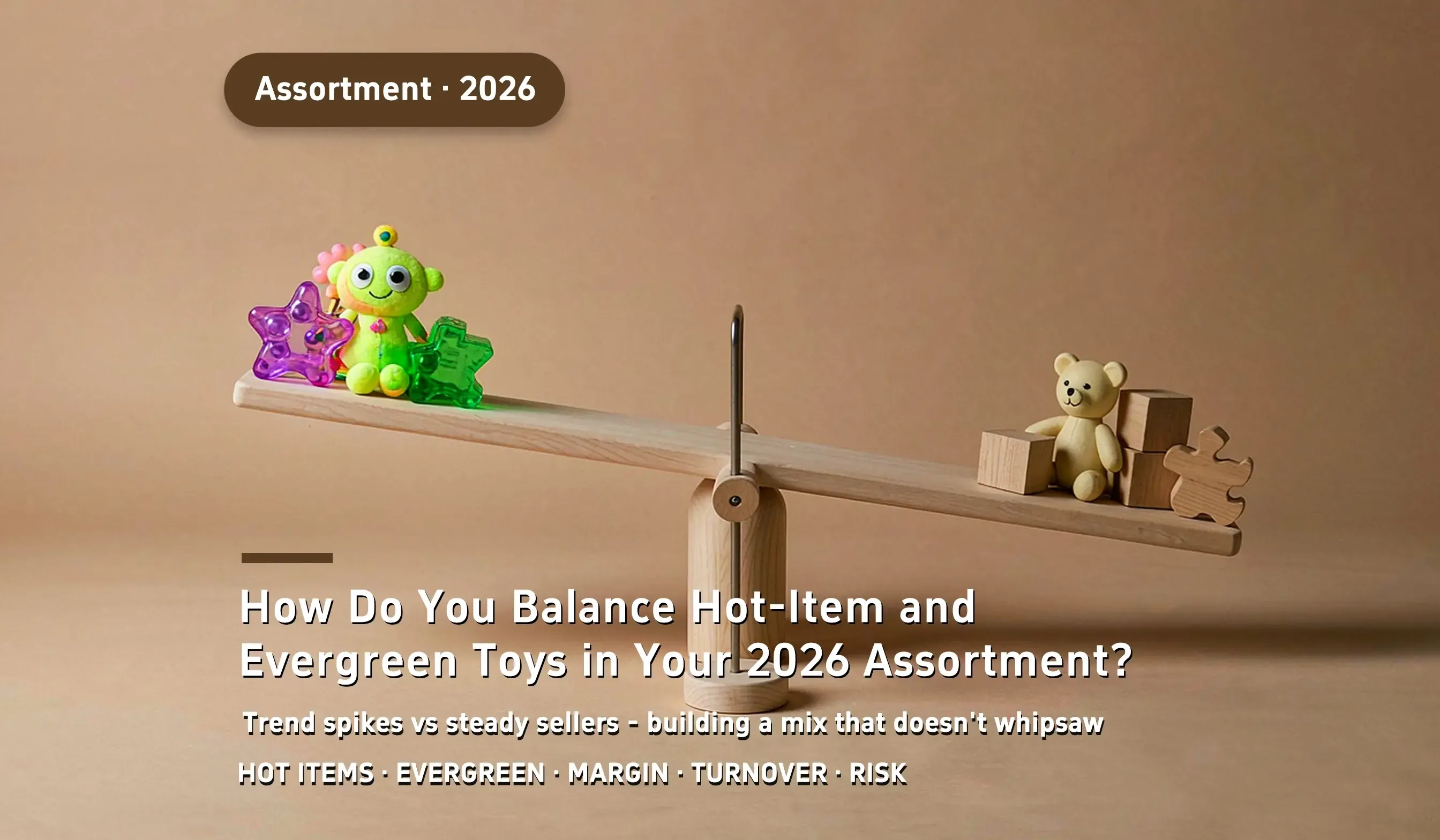
Hot items: the pull and the trap
Hot items ride short-term attention. Social push, an influencer clip, a viral unboxing, a seasonal spike. They can jump fast and pump a quarter's numbers. The catch is the clock: most run 3 to 6 months before attention moves on. High upside, high risk.
The part most supplier blogs skip is where hot items actually hurt importers:
IP is where fads go to die. Trending toys are usually trending because they look like something copyrighted — a character, a show, a brand. Copy it and you don't get a bestseller, you get a takedown that freezes your listings and your account. Source original non-IP only.
Cert lag kills the window. By the time you test, certify, produce and ship a hot item, the trend may already be cooling. Evergreen SKUs reuse existing test files; a rushed hot item often ships without proper docs and sits at customs. Same container, different disaster.
Speed breeds quality drift. Chasing a trend means tight timelines, and tight timelines mean the bulk looks nothing like the sample. One bad batch and the retailer doesn't reorder the hot item or your evergreen line.
Evergreen: your cash-flow base
Evergreen is the boring half that pays salaries. Building blocks, puzzles, classic plush, simple outdoor. Broad age range, steady reorder, low drama. Margin per unit is thinner, but it shows up every month and it doesn't vanish when a TikTok trend ends.
IP risk is lower too, as long as the design is original. A good evergreen block line reorders for years. That predictability is what lets you afford to test the occasional hot item.
Hot item vs evergreen: side by side
| Hot item | Evergreen |
|---|---|---|
Sales rhythm | spike, then fade | steady, repeatable |
Lifecycle | ~3–6 months | years |
Margin per unit | higher | thinner |
Risk | high (IP, cert, fade) | low |
Reorder pattern | one-shot or dead | continuous |
Best use | traffic, gifting peaks | cash flow, base assortment |
They aren't competitors. One brings people in. The other keeps the lights on.
How to balance the mix in 2026
There's no single ratio, but the stage of your business sets the guardrails:
- Starting out: keep evergreen at 70–80%, hot items at 30% or less. Hot items are traffic experiments, not your backbone.
- Established: a 50/50 split works once you know your sell-through and have a stable replenishment beat.
- Peak season (Christmas, back-to-school, regional gifting): bump hot items toward 60% to catch the spike, but only with an exit plan: markdown rules, clearance timing, and a hard stop if sell-through stalls.
Three habits make the ratio real instead of theoretical:
- Test hot items small. Use low-MOQ mixed cartons. Never bet a full container on a fad you haven't sold yet.
- Run a 4–6 week observation window. Track sell-through, repeats, returns, complaints. Reorder only if the numbers hold. Kills emotional buying.
- Adapt, don't invent. A proven block set in a seasonal color, or familiar format with updated packaging, carries far less risk than a brand-new unproven fad. Lighter bets, same traffic.
Toy-industry red lines that decide the mix
This is where the hot/evergreen call meets compliance:
- Original non-IP, always. Hot items are the #1 infringement zone. We design original; we never source licensed looks.
- Per-SKU safety reports. EN71 (EU), ASTM F963 + CPSIA (US), ISO 8124 (global baseline). Evergreen SKUs reuse valid files; hot items must clear the same bar or they sit at customs.
- Age grading & small-parts warnings. Under-3 products avoid detachable small parts. Mis-grading triggers recalls.
- Battery compliance for electronic hot items. UN38.3 + MSDS mandatory; IEC 62115 for electric toys. Missing files = hold and shipping bans.
- No realistic weapon replicas. Banned or restricted in many import markets.
How InLuv Toys helps you run both
We're a Chenghai-based sourcing partner, not a factory, and we build assortments for both rhythms:
- Original, non-IP designs across hot and evergreen lines, so a trend never becomes a takedown.
- Per-SKU EN71 / ASTM test reports, CoC, and material declaration (ABS virgin, BPA-/lead-/phthalate-free).
- AQL 2.5 inspection and production video on every lot, so bulk matches sample.
- Low-MOQ mixed cartons (one carton, many styles) — the practical way to test a hot slice without committing a container.
- 30% deposit / 70% against B/L. Your importing entity holds local cert (SNI / TISI / QCVN / SIRIM / INMETRO / NOM / GCC); we supply the test files underneath.
FAQ
What is the difference between a hot-item and an evergreen toy?
A hot item spikes on trend and fades in months; an evergreen sells steadily for years. One drives traffic, the other drives cash flow.
Are hot-item toys worth the risk for importers?
Yes, in small doses. They pull traffic and margin, but only when sourced original, certified, and tested in low volume first.
How much of my assortment should be hot items?
Start at 30% or less if you're new, move to 50/50 once established, and bump toward 60% only for peak season with an exit plan.
Do evergreen toys still sell?
Steadily. They're the reorder base of most importers' assortment and the safest cash-flow spine.
How do I avoid IP problems with trending toys?
Source original non-IP designs only. Never copy a character, show, or brand look, no matter how hot the trend is.
Build a Balanced Assortment:👉 [Request a Quote at InLuv Toys] · tell us your target market and volume, and we'll send original-design options across hot and evergreen lines, per-SKU compliance files, and a tailored quote within one business day.
Website: www.inluvtoys.com
Email: henry@inluvtoys.com
Phone / WhatsApp / WeChat: +86-13411918746