Sep 7, 2026Product Knowledge
How Do Magnetic and Traditional Building Blocks Compare And Which Should You Import in 2026?
Magnetic vs traditional building blocks for importers: margin, IP risk, magnet safety, age bands, and what to stock in 2026. Sourced original and EN71-compliant by InLuv Toys.
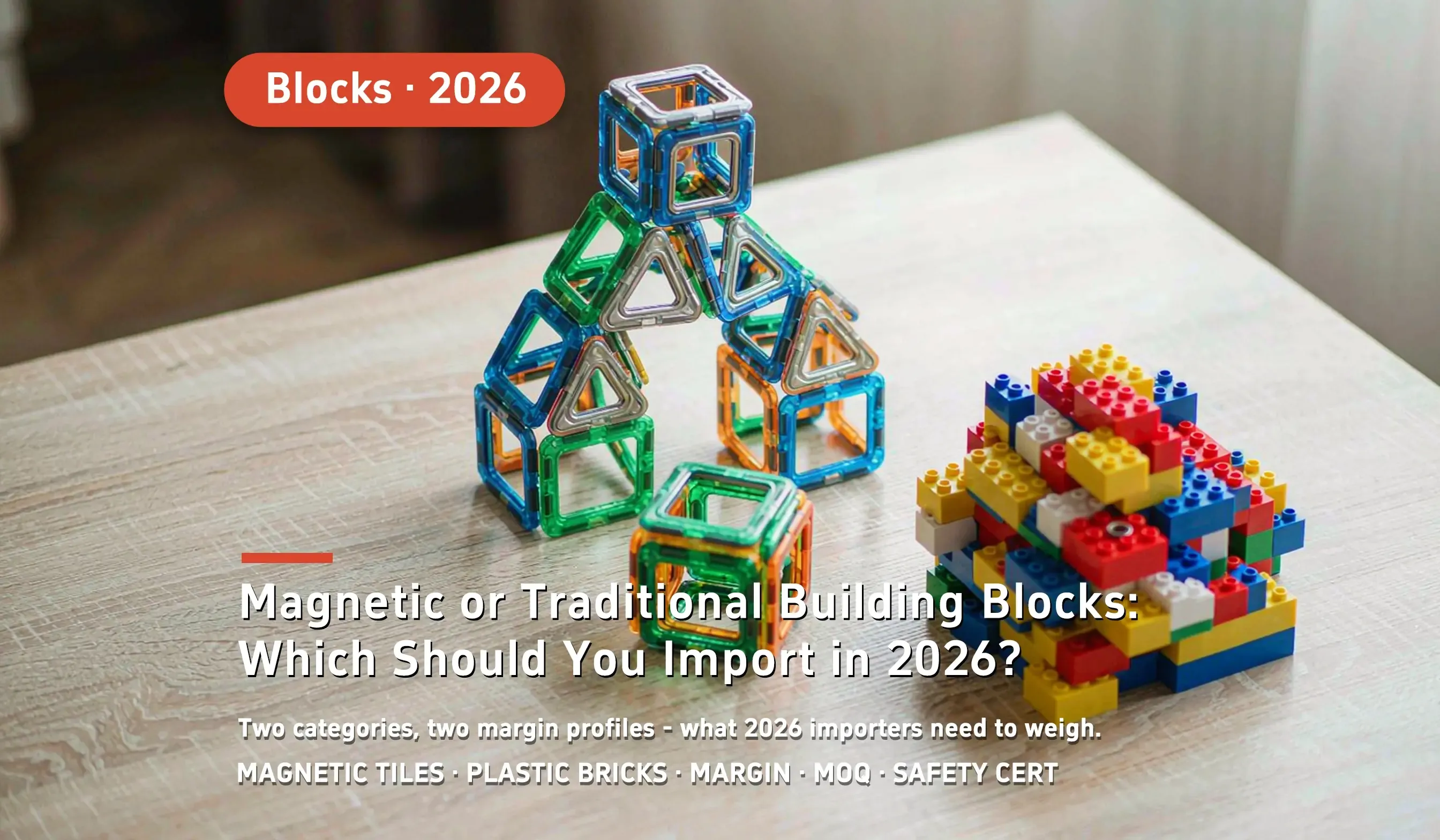
Magnetic building blocks: the margin play
These connect with built-in magnets. Squares, triangles, panels. Kids snap them together fast, which is exactly why they sell: less frustration, more "look what I built." They sit well in the STEM story (shapes, balance, spatial thinking), and on a retail shelf the try-me is instant. A kid picks one up, it clicks, the parent gets it. That conversion is hard to beat.
The unit price is higher than traditional blocks, and so is the perceived value. Margin per carton is usually better.
Here's where it gets dangerous, and where most "magnetic vs traditional" posts go quiet:
Trademark, not just copyright.
The magnetic-tile look is owned. Brands like Magna-Tiles and Connetix hold registered trademarks and design rights. If your factory "makes the popular one," you are importing a lawsuit, not a product. Source original shapes and your own branding, full stop.
Loose magnets are a safety hazard.
Small high-powered magnets are an ingestion risk for young children. The US and EU both restrict them; under-3 is effectively banned in most markets, and even 3+ sets must meet magnet strength and size rules with test files to prove it. A supplier who shrugs at this is a supplier you will get a recall from.
So magnetic blocks are worth carrying. Just never as a copy, and never without magnet-compliance paperwork.
Traditional building blocks: the volume foundation
Wooden, plastic interlocking, plain stackers. They've been around forever because they work. Age range is wide, roughly 1 to 10. Price is low, risk is low, and they reorder like clockwork because every toddler needs a first block set.
Margin per unit is thinner. You make it up on volume and turnover. The downside is commoditization. Everyone sells them, so the only way to stand out is original design and packaging that actually explains the toy in three seconds (see our retail-shelf selection guide).
For a small importer, traditional blocks are the safer first container. Proven demand, fewer compliance surprises, easier to test a market.
Magnetic vs traditional: side by side
| Magnetic sets | Traditional blocks |
|---|---|---|
Connection | magnets | stack / interlock |
Best age | 3+ (magnet rules apply) | 1–10+ |
Ticket price | higher | lower |
Margin per carton | higher | thinner, volume-based |
IP risk | high (trademarked looks) | low if original |
Shelf try-me | strong (instant click) | needs clear packaging |
Safety watch | loose-magnet rules | small-parts under 3 |
Neither replaces the other. They serve different buyers on the same shelf.
What your 2026 assortment should actually include
Don't choose one. A balanced block wall carries both:
- Traditional blocks as the base — large wood or soft sets for 1–3, standard interlocking for the broad middle. This is your repeat-volume spine.
- Magnetic sets as the margin add — one or two original, own-brand SKUs for the 3+ STEM shopper. Higher ticket, higher basket.
- Age logic: 1–3 traditional; 3–6 magnetic starts to pull; 6+ both work and combine well.
If you're starting cold, ship traditional first. Prove the channel. Then add magnetic once you've got a retailer who will pay for the STEM story. Jumping straight to magnetic copies is how importers lose an account and a platform.
How InLuv Toys sources blocks for importers
We're a Chenghai-based sourcing partner, not a factory, and blocks are our core line. For both categories we supply:
- Original, non-IP designs. On magnetic sets that means our own shapes and branding, never a copied tile.
- Per-SKU EN71 / ASTM F963 test reports, plus magnet-strength compliance files for any magnetic product.
- AQL 2.5 inspection and production video on every lot.
- Low-MOQ mixed cartons (one carton, many styles) so you can test a block range without filling a container.
- 30% deposit / 70% against B/L. Your importing entity holds local cert (SNI / TISI / QCVN / SIRIM / INMETRO / NOM / GCC); we supply the test files underneath.
FAQ
Are magnetic building blocks better than traditional blocks?
No. They're different. Magnetic sets win on STEM positioning and margin; traditional blocks win on age range, price and volume stability. Stock both.
What age are magnetic building blocks for?
Generally 3 and up, and only with magnet-compliance test files. Under-3 is restricted in most markets because of loose-magnet ingestion risk.
Is the magnetic tile category safe from IP claims?
No. The popular looks are trademarked. Source original shapes under your own brand, or skip magnetic entirely.
Do traditional building blocks still sell?
Yes, steadily. They're the volume foundation of most toy importers' block category and reorder reliably.
How do I choose a block supplier?
Check for original non-IP design, per-SKU safety reports, magnet compliance on magnetic sets, AQL inspection, and workable MOQ. Avoid any supplier who treats trademarks or magnet safety as someone else's problem.
Get a Block Assortment Quote:👉 [Request a Quote at InLuv Toys] · tell us your target market and volume, and we'll send original-design block options (magnetic + traditional), per-SKU compliance files, and a tailored quote within one business day.
Website: www.inluvtoys.com
Email: henry@inluvtoys.com
Phone / WhatsApp / WeChat: +86-13411918746