Aug 11, 2026Product Knowledge
A Toy Buyer’s $3,000 Lesson: Why the Cheapest Quote Almost Bankrupted a Small Brand
And how we turned a sourcing nightmare into a transparent system any buyer can use.
Last November, we received a panicked call from a customer in Texas. Let’s call him Mike.
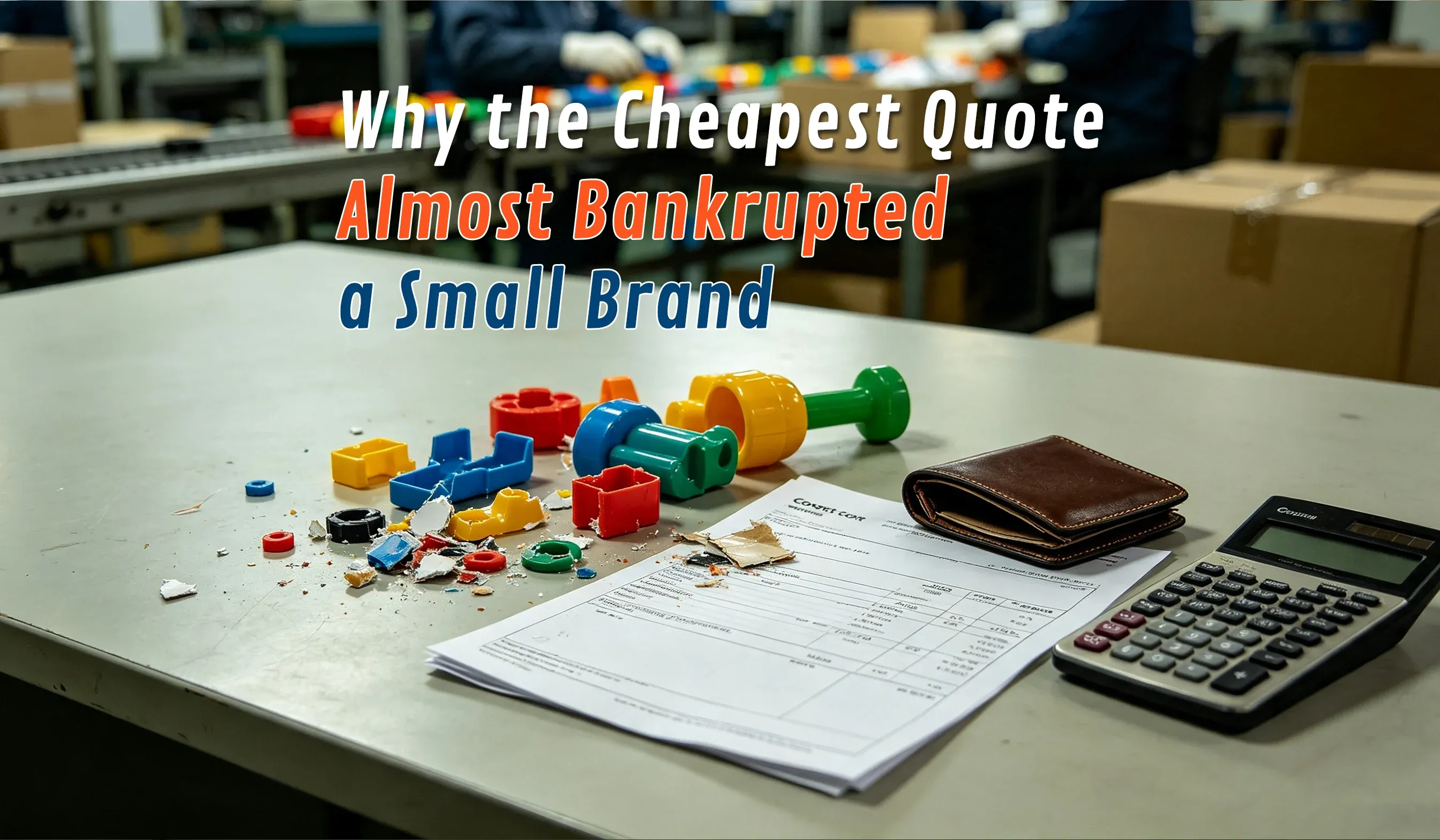
Mike runs a small but growing toy brand. Six months earlier, he had sourced 3,000 units of a dinosaur building block set from a new supplier. The quote was 32% lower than ours. The product photos looked identical. The spec sheet appeared complete. The decision felt like a no-brainer.
But when the container arrived, Mike’s dream turned into a disaster.
- The colors were blotchy and inconsistent. Some dinosaurs looked like they had survived a fire.
- The plastic felt thin and brittle. Several pieces snapped during the first playtest.
- Worst of all, the shipment was flagged at the port because the lab test report didn’t match the actual material. The entire batch was held for weeks.
Mike spent over $3,000 in extra warehousing fees, rework, and lawyer consultations. His launch was delayed by four months. By the time he finally got the goods, he had lost the peak season.
He called us not to complain—but to ask if we could fix the mess.
That’s when we realized: the problem wasn’t Mike. It was the way the toy industry hides the truth inside a single number.
Why “Same Product” Doesn’t Mean Same Quote
A 20–30% price gap is common in the toy industry. But that gap rarely comes from one factor. It’s a layered construct. Understanding those layers is how you stop comparing illusions.
Here is what actually drives the difference.
1. Material Grade: The Invisible Backbone of Your Product
Two ABS plastic dinosaurs can look identical in a photograph. But one is made from virgin ABS (like LG Chem or Chi Mei), and the other from recycled regrind mixed with unknown fillers.
What does the buyer see?
- A bright, sharp product photo.
What does the buyer get?
- Color shift from batch to batch
- Lower impact strength, meaning parts break during shipping
- Potential heavy metal contamination if the recycled source is uncontrolled
We once tested a “low-cost” sample against our standard. The cheap plastic had 40% lower tensile strength and failed the EN71 migration test for cadmium. The client would never have known without a third-party lab report.
Ask your supplier: “What is the exact grade and brand of raw material? Can you provide a material certificate for each production batch?”
2. Quality Control: The Cost of Certainty
Every toy factory says they “do inspection.” But what does that actually mean?
- Option A: The factory does a basic visual check at the end of the line. One inspector glances at 500 pieces a day.
- Option B: The factory conducts in-line inspections at three stages (molding, assembly, packing), plus a full AQL 2.5 final inspection, plus pre-shipment testing coordination.
Option B costs more. It requires more staff, more time, and more documentation. But it also catches problems before they become 3,000 defective units sitting in your warehouse.
We’ve had clients who initially asked to skip the in-line inspection to “save cost.” One of them ended up with 15% of the order having misassembled limbs. The cost of replacing those parts was 8x what the inspection would have cost.
Ask: “Which inspection stages are included? What AQL standard do you use for final inspection? Who pays for the rework if defects exceed the agreed level?”
3. Packaging: The Hidden Cost Amplifier
A quote of $2.50 per unit might sound great—until you discover it’s for a bare polybag only.
Now add:
- Full-color offset printed window box: +$0.35
- Inner tray with die-cut foam: +$0.18
- Barcode sticker and price tag: +$0.05
- Master carton with upgraded 5-ply corrugated (to survive ocean freight): +$0.12
Suddenly your 3.20. That’s a 28% jump. None of this is “extra”—it’s the reality of getting a product onto a retail shelf intact.
We’ve seen suppliers deliberately quote the bare minimum to win the order, then roll out the “necessary packaging adjustments” as add-ons. By that point, the buyer is already committed.
Ask: “Is the quote based on the exact packaging spec I provided? Please list every packing material included, down to the inserts and labels.”
4. After-Sales Responsibility: Who Carries the Risk?
A low quote often means the risk sits entirely with the buyer once the container leaves the factory gate.
If 200 pieces arrive broken, who pays?
If the barcode doesn’t scan, who fixes it?
If the colors don’t match the sealed sample, who covers the discount to the retailer?
Some suppliers quietly exclude all these responsibilities. There’s no malicious intent—it’s simply not in the price.
We learned early on that after-sales isn’t a cost; it’s a promise. Our standard terms include a 2% free-of-charge spare parts provision on every order. That buffer alone has saved countless relationships when things inevitably go wrong during transit.
Ask: “What exactly happens if I receive defective goods? What is the replacement policy, and how fast can it be executed?”
The Three Traps That Cost Mike His $3,000
Mike’s case wasn’t random. It followed a pattern we’ve seen too many times.
Trap 1: The Material Bait-and-Switch
Mike’s approved sample was made with virgin ABS. The bulk production? A blend with over 60% regrind. The sample passed the lab test; the bulk cargo didn’t.
The supplier never explicitly stated the material would change. They just didn’t promise it wouldn’t. And Mike, not knowing to ask, assumed the sample represented production.
Lesson: Lock the material standard in a written document. Stipulate that bulk material must match the approved sample’s composition, and reserve the right to random third-party testing.
Trap 2: The Creeping Extra Charges
After the deposit was paid, Mike received a list of “additional required costs”:
- Artwork design fee for the box
- Palletizing for export
- Certificate of Origin processing
- “Special handling” for the urgent shipment
Each charge was small enough to accept under pressure. Together, they added 18% to the unit cost. But by then, canceling would have cost even more.
Lesson: Demand an all-inclusive quote breakdown before you place the order. If a line item says “to be confirmed,” treat it as a red flag.
Trap 3: The MOQ Illusion
The $1.68/unit price Mike was quoted? It was based on a 10,000-unit order. Mike ordered 3,000. The supplier “graciously” agreed to keep the same unit price for the trial order—but only by cutting corners on material and packaging to preserve their margin.
Lesson: Always get a specific price for your exact trial order quantity. If the unit price jumps dramatically, ask why. A transparent factory will explain the cost structure honestly.
A Practical Toolkit: How We Quote, and How You Can Compare
After Mike’s experience, we developed a standard transparency framework. It’s not rocket science—it’s just a promise to show every line before a single dollar changes hands.
Here is the exact comparison checklist we provide to every new buyer. Use it to level the playing field.
Comparison Item | What InLuv Toys Confirms | What You Should Verify |
|---|---|---|
Product Specification | Exact dimensions, weight, function, accessories, battery type if any | Same level of detail from other suppliers |
Material | Virgin ABS (Chi Mei PA-757) or specified grade; certificate provided | Material brand, grade, and whether regrind is allowed |
Packaging | Full breakdown: inner box, outer carton, labels, inserts, barcodes, pallet | Every component listed with price |
Testing & Inspection | In-line (3 stages) + AQL 2.5 final + EN71/ASTM coordination; cost included | Standards, who pays for testing and rework |
Order Quantity | Price for your exact MOQ, plus volume break tiers | No “bait and switch” quantity |
Delivery Terms | FOB Shenzhen (Incoterms specified); named port | Consistent terms across quotes |
Production Schedule | Standard lead time, express line option, and overtime policy | Clear lead time and delay penalties |
Additional Costs | Mold, artwork, printing plates, courier, loading, certificates | Any item marked “TBD” is a risk |
After-Sales | 2% free spare parts, defect replacement within 15 days | Responsibility, timeline, and cost of after-sales issues |
Why Transparency Wins (Even If It Costs Slightly More)
After the mess was sorted, Mike placed his reorder with us. Our price was 12% higher than the original cheap quote—but it included everything. No surprises. No late-night panic calls. His second launch went smoothly, and he’s now one of our longest-standing partners.
The lowest quote is rarely the lowest total cost. A transparent quote might look a few cents higher on paper, but it typically includes:
- Consistent material quality (no lost customers due to safety scares)
- Predictable inspection results (no demurrage fees at customs)
- Packaging that survives shipping (no damaged goods and chargebacks)
- Support when something goes wrong (because it sometimes does)
The real savings aren’t in the unit price. They’re in the costs you don’t incur.
Your Next Step: Steal Our Transparency Template
If you’re currently comparing quotes and feel overwhelmed by the numbers, we’ve prepared two tools you can use today—no strings attached.
- The InLuv Toy Quotation Transparency Template A fillable spreadsheet that forces every supplier to quote in the same detailed format. You’ll immediately see which factory is hiding costs.
- The Toy Material Grade Guide A simple visual guide explaining common plastic grades (ABS, PP, PVC), how to identify regrind, and what tests to request.
Just send us an email at [your email address] with the subject line “Transparency Tools”, and I’ll send both to you personally. No sales pitch, no follow-up calls—just the tools.
Because we believe a good toy partnership doesn’t start with the lowest number. It starts with the clearest one.
Website: www.inluvtoys.com
Email: henry@inluvtoys.com
Phone / WhatsApp / WeChat: +86-13411918746